
Integrating a high-pressure homogenizer into an automated production line requires more than simply connecting the machine to existing pipes. The homogenizer needs to work smoothly with feeding, mixing, heating or cooling, storage, filling, and cleaning systems. When these stages are properly coordinated, manufacturers can achieve more consistent processing, reduce manual intervention, and make better use of production capacity. The first step is to understand the complete production process. Before installing a homogenizer, manufacturers should identify where homogenization is required and determine how the material will enter and leave the machine. The required flow rate, processing pressure, product viscosity, temperature, and formulation characteristics should be considered together. This helps determine the appropriate homogenizer capacity and prevents bottlenecks elsewhere in the line.
A stable feeding system is particularly important. High-pressure homogenizers require a consistent supply of material to operate properly. A suitable feed tank, mixing system, pump, and pipeline arrangement can help maintain steady product flow into the homogenizer. If the upstream system cannot provide sufficient and consistent feed, the homogenizer may not achieve stable processing results even when the machine itself is correctly selected. Pressure control is another essential part of automation. Modern production lines can use pressure sensors and control systems to monitor homogenization conditions continuously. Operators can establish suitable pressure parameters according to the formulation and production requirements. Automated monitoring also makes it easier to identify abnormal pressure changes before they develop into more serious equipment or production problems.
Temperature management should be considered at the same time. High-pressure processing can increase product temperature, while some formulations are sensitive to temperature changes. Depending on the application, heat exchangers or cooling systems may therefore be installed before or after homogenization. Connecting temperature sensors to the central control system allows the production line to monitor these changes and maintain the desired processing range. Pipeline design is another area that deserves careful attention. Pipes, valves, fittings, and pumps should be compatible with the homogenizer's flow requirements and the characteristics of the processed material. Unnecessary bends, restrictions, or poorly positioned valves can increase pressure losses and make cleaning more difficult. A well-designed pipeline layout supports stable material transfer and simplifies maintenance.
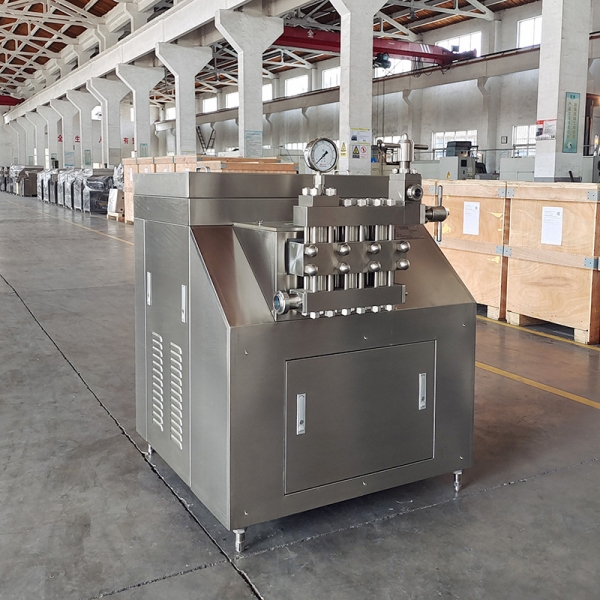
Automation also makes it possible to coordinate the homogenizer with upstream and downstream equipment. For example, the control system can manage the sequence between feed pumps, mixing tanks, homogenization, cooling, and filling equipment. Interlocking functions can prevent the homogenizer from starting when essential conditions have not been met, helping protect both the machine and the production process. Cleaning should be included in the automation plan from the beginning. In food, beverage, pharmaceutical, and cosmetic applications, production equipment may require regular cleaning and sanitation. A properly designed cleaning system can reduce manual work while helping ensure that product-contact surfaces are cleaned consistently. The homogenizer should therefore be considered as part of the complete cleaning circuit rather than as an isolated machine.
Data collection can further improve automated homogenization. Parameters such as pressure, temperature, flow rate, operating time, and maintenance status can be monitored and recorded by a production control system. Historical data can help manufacturers identify process changes, investigate quality deviations, and establish more effective preventive maintenance schedules. Safety controls are equally important when integrating high-pressure equipment. Emergency stops, pressure protection, alarms, and appropriate interlocks should be incorporated into the control system. The automation strategy should ensure that abnormal conditions can trigger an appropriate response rather than allowing the homogenizer to continue operating under unsuitable conditions.
Finally, successful integration depends on matching the homogenizer to the entire production system rather than selecting the machine based only on maximum pressure or flow rate. Changzhou Chaoli Homogenizer Factory provides high-pressure homogenizer models for applications including food and cosmetics, pharmaceutical engineering, biologics, and nano materials. Its range includes models such as 3011, 3015, 3030, 3045, 3090, and 4110, allowing equipment selection to be considered according to different processing requirements. A high-pressure homogenizer can become an important part of an automated production line when feeding, pressure, temperature, pipelines, controls, cleaning, and safety systems are designed together. Proper integration helps manufacturers achieve repeatable processing conditions while reducing unnecessary manual intervention. For companies planning a new production line or upgrading an existing one, considering the homogenizer as part of the complete process system is an important step toward reliable and efficient production.
