High-Pressure vs. Low-Pressure Homogenizers – What’s the Difference?
Homogenization is a key process used in many industries such as food and beverages, pharmaceuticals, cosmetics, and chemical processing. The purpose of homogenization is to break down particles or droplets and distribute them evenly throughout a mixture, creating a stable and uniform product. However, not all homogenization equipment operates in the same way. The two main types are high-pressure homogenizers and low-pressure homogenizers, and understanding their differences can help manufacturers choose the right technology for their production needs. Low-pressure homogenizers typically operate at lower pressure levels and are mainly used for simple blending or mixing applications. These machines are often suitable for processes where the main goal is to combine ingredients rather than significantly reduce particle size. Low-pressure systems rely primarily on mechanical agitation or mild pressure to disperse materials. While they can achieve basic uniformity, they may not provide the level of particle refinement needed for products that require smooth textures or long-term stability.
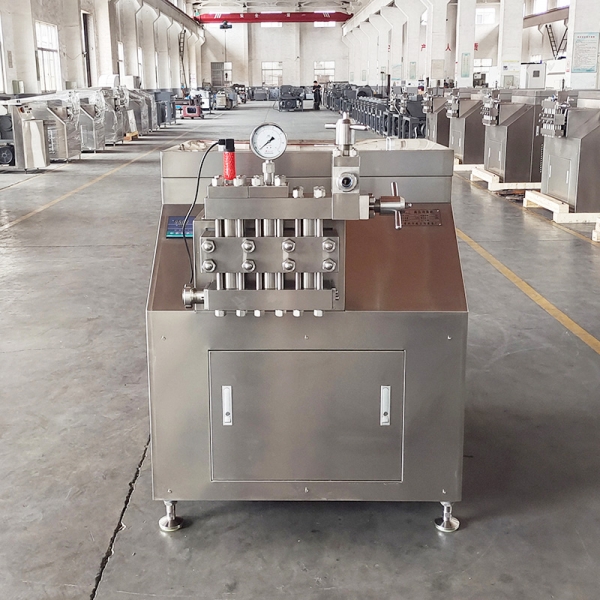
High-pressure homogenizers, on the other hand, operate at significantly higher pressure levels and are designed for advanced particle size reduction and emulsification. During the process, the liquid mixture is forced through a narrow homogenizing valve at high pressure. This creates intense forces such as shear, turbulence, and cavitation, which break down particles into much smaller sizes. As a result, the mixture becomes more stable, smoother in texture, and less likely to separate over time. One of the major advantages of high-pressure homogenizers is their ability to produce extremely fine emulsions and suspensions. This is particularly important in industries like dairy processing, beverage production, pharmaceuticals, and cosmetics, where product quality depends heavily on particle size and uniformity. For example, homogenized milk achieves a smooth texture and prevents cream from separating, while cosmetic creams benefit from a more stable and silky formulation.
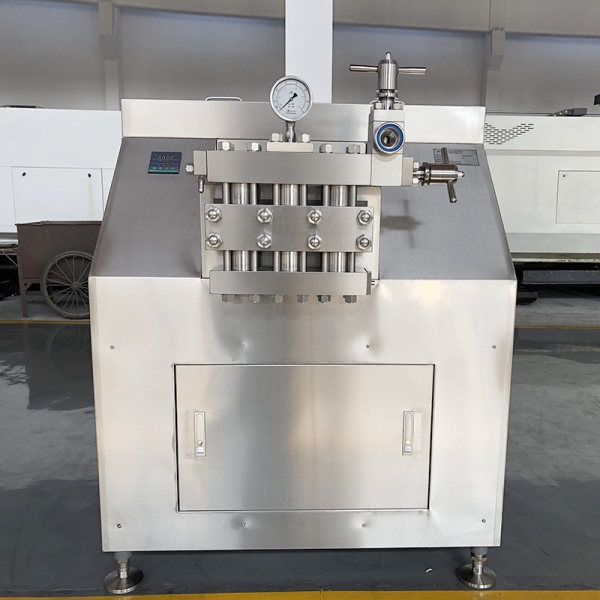
Another difference between the two systems lies in their processing capabilities. Low-pressure homogenizers are generally suitable for small-scale or less demanding applications. High-pressure homogenizers are designed for more complex formulations and high-performance production environments. They can handle materials that require precise particle control, such as nano-material dispersions, biologics processing, and pharmaceutical suspensions. Production efficiency is also affected by the type of homogenizer used. High-pressure homogenizers often deliver faster and more consistent results because they can achieve the desired particle size reduction in fewer processing cycles. This efficiency makes them ideal for industrial-scale production where consistency and throughput are essential. In contrast, low-pressure systems may require longer mixing times or additional processing steps to reach acceptable results.
When choosing between high-pressure and low-pressure homogenizers, manufacturers must consider factors such as product requirements, production volume, desired particle size, and process complexity. For applications that demand fine particle distribution, strong emulsion stability, and reliable large-scale processing, high-pressure homogenizers are typically the preferred solution. Low-pressure systems, however, can still be useful for simpler blending tasks where advanced homogenization is not necessary. In modern manufacturing environments where product quality, stability, and efficiency are critical, high-pressure homogenization has become the industry standard for many advanced applications. By selecting the appropriate homogenization technology, manufacturers can ensure consistent performance, improve product quality, and meet the growing expectations of today’s global markets.